
A moment of sublime astonishment comes at the end of a film bathed in disturbing awe – the film being Jonathan Glazer’s The Zone of Interest (2023). Auschwitz Commandant Rudolf Höss (Christian Friedel), arch-functionary, descends a barren staircase. This arriviste loser has previously been socially out of depth at a party function. Here he returns to more concrete things: his office building. This is terra firma for the high-functioning bureaucrat.
Descending the stairs, he suddenly finds himself retching yet no vomitus materialises. Another round of stairs, another retch, and still no vomitus. Is this his inability to feel disgust at what he does? Or is this, we hope (counterfactually), the first inkling of the horror that he is personally overseeing?
He then stares into the black void down the end of a corridor, and the corridor seems to stare back at him. When it does so, it is the future staring – as the film pivots to the present-day Auschwitz Museum and cleaners hoovering the gas chambers, polishing the black iron of the ovens, dusting the rows of display cases containing what remains of the dead: empty shoes.
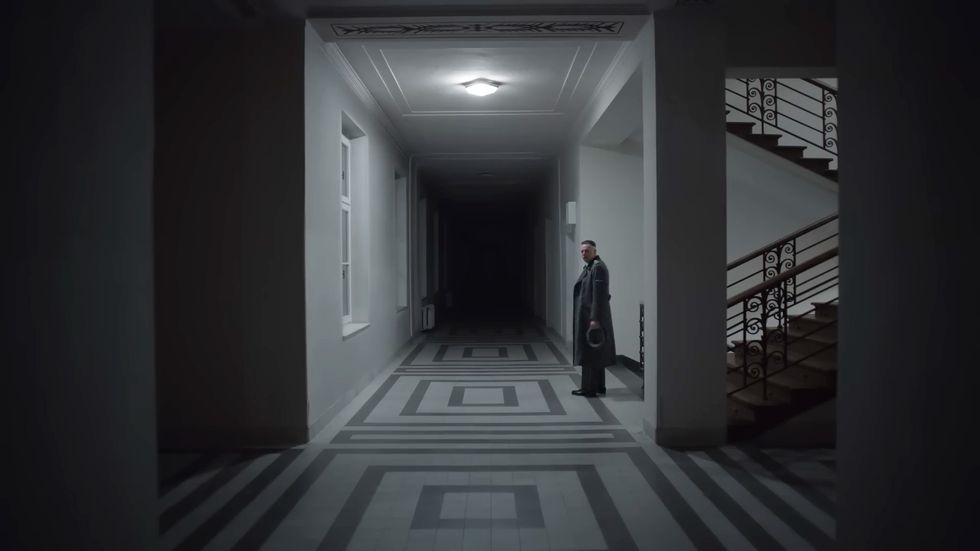
At this moment, Höss seems to have caught us in 2024 watching him, judging him – an uncanny fracturing of the Fourth Wall.
Cinema has seen this trick before – the past becoming colourfully present. Spielberg’s Schindler’s List (1993)) does it. Perhaps it is a necessary transition as if to show how such seemingly distant ‘black-and-white’ history lives on in the colour of the present. What makes Glazer’s film different is that his film then pivots back to Höss. This is Glazer’s masterstroke. I couldn’t help feeling that this was almost a plea for what philosopher’s call Presentism- that the present is the only thing that exists, or that everything is present. Thus, here the ‘future’ (merely a changed present) is already there in 1943 judging him. It is right there down that corridor, out of sight but also present. That if Höss had understood this he might have acted differently, as other Germans implicated in such horrors might have. And how, if we too understood this, we would all act differently every day of our lives.
What, then, is this strange minor breakdown in the automaton-like Höss? A sense of future judgement niggling him somewhere in the unfathomable interstices of his conscience? If so, it lasts a few minutes only. He adjusts his hat, and continues his descent – literal and metaphorical – into his immediate future of Semitic annihilation.
The black void at the end of that corridor is a familiar Glazer ‘black box’ containing all that remains unknowable about human actions: we know inputs (Nazi ideology, anti-Semitism) and outputs (6 million dead Jews), but what lies in-between the two? Such opacity is, alas, catnip to Holocaust deniers. It is the same void of Under The Skin (2013), where female being, or, if you like, ‘alien being’, or simply Desire, is shown to us in its stark unknowability. It appears on one of The Zone of Interest’s film posters inking out the eternal blue sky of that summer. It is a void which refutes our enquiry. It is Nietzsche’s abyss staring back at us.
Indeed, the film is bookended with black boxes. There is the bold ‘fuck you’ opening cinematic black screen immersion, as Mica Levi’s (and Johnnie Burn’s) uncanny sound world leaches into us, creating the unsettling mode-of-viewing that will reside for the entirety of the film. Could we be in a lightless train carriage hurtling towards the ‘black box’ of Auschwitz? Could this even be an attempt to represent the gas chamber? Or does that come at the end, where Levi’s demented sounds take on an unbearably frenzied sense of horrific desperation?
Glazer’s film is a masterpiece of defamiliarization, of making Auschwitz seem newly horrific. He re-disturbs us to the core of our being, waking us up from the slumbers of history, from some fatal ennui borne out of over-familiarity, of what risks becoming a mere trope, cinematic shorthand for ‘the worst of us’.
Glazer, and his co-creator Mica Levi, are surely right to be considered avant-garde. Such unorthodoxy is no doubt necessary for art in the ‘always on’ media-saturated world of streaming. It is reassuring, too, that such 10-year commitments can pay off; that cinema can still disclose and enact such necessary horror.
 Neil-Fitzgerald.com