Black Seas of Infinity: The Alien Sound-World of Georg Friedrich Haas

https://i0.wp.com/www.musicaustria.at/sites/default/files/bilder/2010/georg-friedrich-haas_c_astrid_ackermann.jpg

Photo © Astrid Ackermann.

Music, always inhospitable to ekphrasis or literary description, seems doubly so when it’s not even typically ‘musical’, which the sound-worlds of the contemporary Austrian composer Georg Friedrich Haas are not. How to capture the ways this weird sonic world emerges almost organically, ex nihilo, like life itself, mutating, growing, pulsing, speeding up, slowing down, or coming suddenly to a stop. These are soundscapes on a vast scale: gigantic rotating planets, slowly warping architectonics, shimmering stillnesses glowing like the aurora borealis. This microtonal music (also referred to as ‘spectral’) finds its forerunner in the micropolyphonic world of the Hungarian composer György Ligeti, the eerie sonic hovering between tones of Atmosphères which Kubrick memorably heard as harmonia mundi, the Music of the Spheres, in 2001: A Space Odyssey.

Perhaps the best ekphrasis would be to quote HP Lovecraft’s vision of the cosmos:

The most merciful thing in the world, I think, is the inability of the human mind to correlate all its contents. We live on a placid island of ignorance in the midst of black seas of infinity, and it was not meant that we should voyage far. The sciences, each straining in its own direction, have hitherto harmed us little; but some day the piecing together of dissociated knowledge will open up such terrifying vistas of reality, and of our frightful position therein, that we shall either go mad from the revelation or flee from the deadly light into the peace and safety of a new dark age.

Here are those ‘black seas of infinity’, the ‘terrifying vistas of reality’, depicted in sublime slabs of abstract sonic pulses. The shards of pseudo-melody which occasionally emerge seem even weirder when they do. It puts me in mind of the new philosophical school of the Object-Oriented: perhaps Haas is composing sonic hyperobjects, or preparing us for the post-human world.
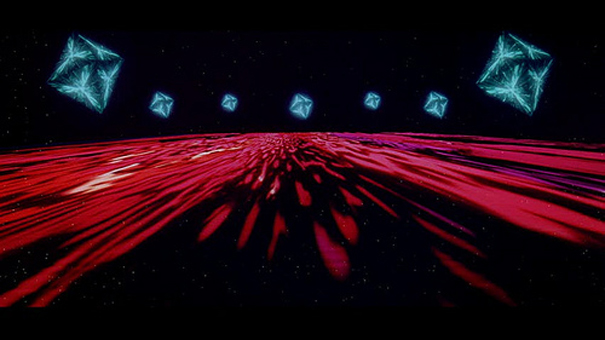
Screen-grab from Stanley Kubrick's 2001: A Space Odyssey © Warner Bros. Entertainment Inc.

Screen-grab from Stanley Kubrick’s 2001: A Space Odyssey © Warner Bros. Entertainment Inc.

Does the word ‘music’ even apply here? Does it even matter?  This will be noise to most, as it would have been to me but a few months ago, when I was all Bach and Beethoven, Mahler and Shostakovich, and this would have irked me into violent vocal derision. But then something clicked and its almost drone-like emergence, continuation, disappearance, anti-melodic swells of sound, pure, impure, but not noise (whatever that is), and not irksome. It now chimes offering a sort of mental consolation for the fuzzy logic of the world, a counterfoil to modern life’s dissonant overload. To quote Kafka in his Diaries, it bears me out like a friend.

Recommended Listening:

‘Different-Different But Same’: The Will To Homogenisation

It’s Saturday night. You head to the new gastropub which has garnered a reputation for offering something different. You order the smoked pigeon. It arrives on some vast alabaster dish that can’t decide if it’s a bowl or a plate. The food is stacked up in the centre, covered in various flowers, crumbs and savoury popcorn, with several blobs of gel and ejaculates of sauce daubed circumferentially around it.

The ‘Mackerel Marsala’ that follows is no different. And it’s the same story down the road at the more traditional boozer: chips are thrice-cooked and served in quaint baskets; burgers come in the mandatory ‘brioche bun’; wooden chopping boards and slate roof tiles act out as plates. Both pubs foreground the locality of the produce on their menus, ‘local’-ness having become just another brand, another way to market your menu as virtuous, ‘ethically-sourced’. Even the seasons aren’t spared: we drown in pre-festival fanfares – Easter, Halloween, Christmas; we are returned to the medieval with seasonal produce, spring greens, early asparagus, what have you. Here, then, is uniform difference: the will to homogenisation on a plate.

Medieval wooden platters are back in demand.

It is tempting to blame MasterChef or one of the many other cookery programmes which cling limpet-like to the TV schedules, to see them as producing a peculiar feedback cycle of demand and supply in terms of proffered dishes and ‘plating up’. The customer has seen those blobs of gel on TV, or had those ‘triple-cooked’ chips somewhere else, and now they want it that way here, too. But I think there is something more fundamental at work here: the will to homogenise isn’t restricted to gastronomy. High Streets, hairstyles, talent shows on TV . . . options narrow down into a blancmange of uniformity. Threatening complexity is reduced to something more easier to categorise and apprehend. The model of neoliberalism and its predatory hyper-capitalism is to assimilate, commodify, monetise until the market is super-saturated, then tweak and repeat. Nothing escapes. Originality, novelty, difference: all becomes subsumed into the homogenising system, fetishised by marketing gurus and media nodes as this season’s must-eat, must-read, must-see, must-do. What begins in one locale eventually becomes ubiquitous, national, transnational: pale baguettes and chewy macaroons on every supermarket shelf.

Anyone who has spent any time in South-East Asia will be familiar with the sales pitch-cum-philosophical mantra, Same Same But Different. The will to homogenisation results in a reversal of this axiom – in seeking to be different-different things become increasingly similar.

1012363620_f87f199080_o

Same form, different colour.

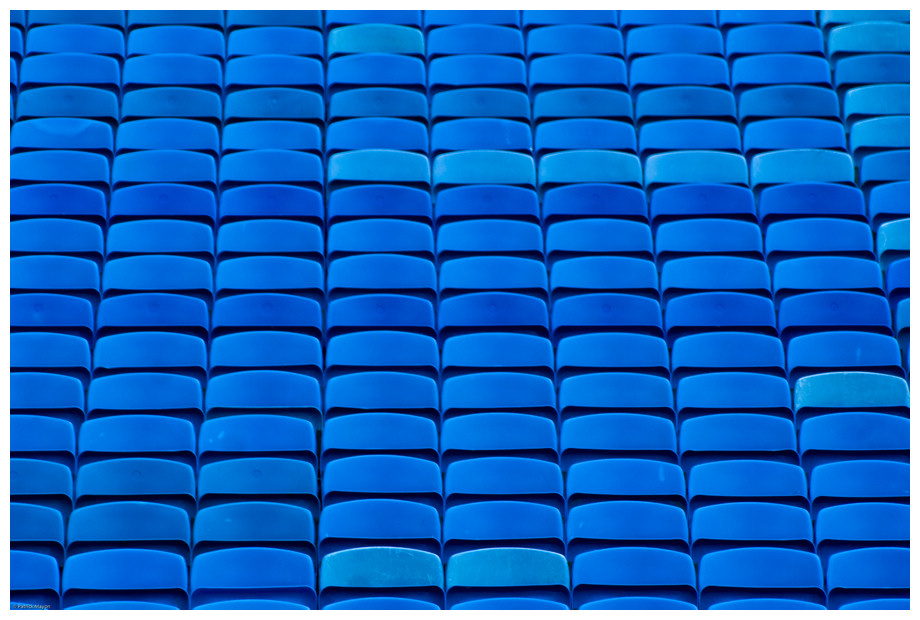
Researching photographs for this essay, I noticed how rare real uniformity is: the windows in those vast housing estates and skyscrapers had a curtain pulled to, a sticker, reflected clouds; the stadium chairs either bore an individuating number or reflected the light differently, turning its aquamarine blue more eggshell; one can imagine up close that each would have unique pattern of scratches, unique fungal knots of hardened chewing gum, graffiti, what have you. Objects seem to resist homogenisation even when mass-production forms them as such. Time and light transfigure them into individuated entities.  The will to homogenisation, borne of capitalism, and thus, borne out of the human condition, is ultimately thwarted, happily so for those who desire difference.  Whereas the complexity of the universe emerged from a singularity, all life on earth from fairly simple building blocks.

Heterogeneity and variation are elemental parts of organic life (evolution through random mutations); the will to homogenise is man-made and finds its purest outlet in the capitalist model, striving for a globalised village of branded stores selling the same branded goods via the same marketing methods. It engenders a dystopian vision of endless rows of sameness on the shelves and on our plates, where the critical room to manoeuvre and think differently enough to critique the system is increasingly diminished. Homogenisation is anti-life, predatory hyper-capitalism a form of hyper-fascism. In the long run, life and difference will win.


Food image by Franek N and stadium chairs by Patrick Mayon. Both used under a Creative Commons license.