The Zone of Interest and the Black Box of History

A moment of sublime astonishment comes at the end of a film bathed in disturbing awe – the film being Jonathan Glazer’s The Zone of Interest (2023). Auschwitz Commandant Rudolf Höss (Christian Friedel), arch-functionary, descends a barren staircase. This arriviste loser has previously been socially out of depth at a party function. Here he returns to more concrete things: his office building. This is terra firma for the high-functioning bureaucrat.

Descending the stairs, he suddenly finds himself retching yet no vomitus materialises. Another round of stairs, another retch, and still no vomitus. Is this his inability to feel disgust at what he does? Or is this, we hope (counterfactually), the first inkling of the horror that he is personally overseeing?

He then stares into the black void down the end of a corridor, and the corridor seems to stare back at him. When it does so, it is the future staring – as the film pivots to the present-day Auschwitz Museum and cleaners hoovering the gas chambers, polishing the black iron of the ovens, dusting the rows of display cases containing what remains of the dead: empty shoes.
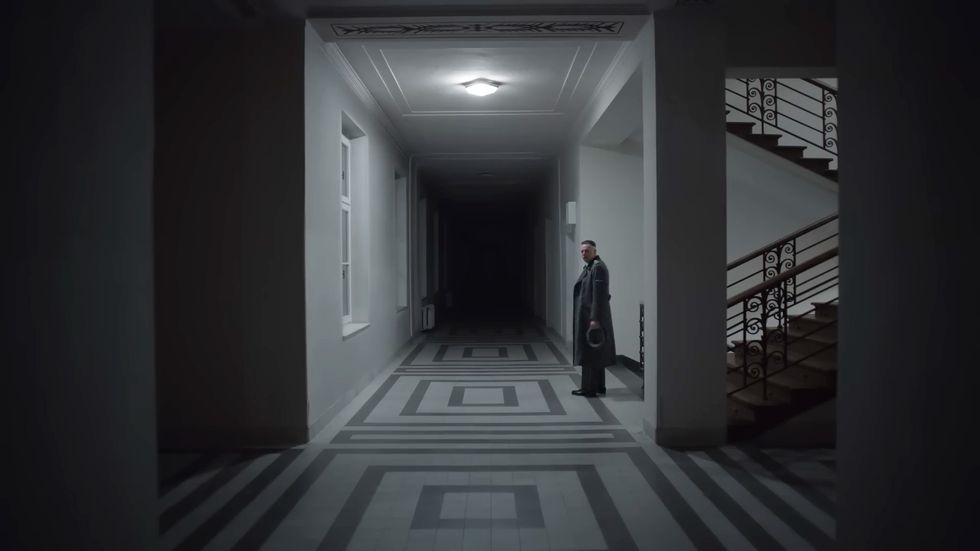
At this moment, Höss seems to have caught us in 2024 watching him, judging him – an uncanny fracturing of the Fourth Wall.

Cinema has seen this trick before – the past becoming colourfully present. Spielberg’s Schindler’s List (1993)) does it. Perhaps it is a necessary transition as if to show how such seemingly distant ‘black-and-white’ history lives on in the colour of the present. What makes Glazer’s film different is that his film then pivots back to Höss. This is Glazer’s masterstroke. I couldn’t help feeling that this was almost a plea for what philosopher’s call Presentism- that the present is the only thing that exists, or that everything is present. Thus, here the ‘future’ (merely a changed present) is already there in 1943 judging him. It is right there down that corridor, out of sight but also present. That if Höss had understood this he might have acted differently, as other Germans implicated in such horrors might have. And how, if we too understood this, we would all act differently every day of our lives.

What, then, is this strange minor breakdown in the automaton-like Höss? A sense of future judgement niggling him somewhere in the unfathomable interstices of his conscience? If so, it lasts a few minutes only. He adjusts his hat, and continues his descent – literal and metaphorical – into his immediate future of Semitic annihilation.

The black void at the end of that corridor is a familiar Glazer ‘black box’ containing all that remains unknowable about human actions: we know inputs (Nazi ideology, anti-Semitism) and outputs (6 million dead Jews), but what lies in-between the two? Such opacity is, alas, catnip to Holocaust deniers. It is the same void of Under The Skin (2013), where female being, or, if you like, ‘alien being’, or simply Desire, is shown to us in its stark unknowability. It appears on one of The Zone of Interest’s film posters inking out the eternal blue sky of that summer. It is a void which refutes our enquiry. It is Nietzsche’s abyss staring back at us.

Indeed, the film is bookended with black boxes. There is the bold ‘fuck you’ opening cinematic black screen immersion, as Mica Levi’s (and Johnnie Burn’s) uncanny sound world leaches into us, creating the unsettling mode-of-viewing that will reside for the entirety of the film. Could we be in a lightless train carriage hurtling towards the ‘black box’ of Auschwitz? Could this even be an attempt to represent the gas chamber? Or does that come at the end, where Levi’s demented sounds take on an unbearably frenzied sense of horrific desperation?

Glazer’s film is a masterpiece of defamiliarization, of making Auschwitz seem newly horrific. He re-disturbs us to the core of our being, waking us up from the slumbers of history, from some fatal ennui borne out of over-familiarity, of what risks becoming a mere trope, cinematic shorthand for ‘the worst of us’.

Glazer, and his co-creator Mica Levi, are surely right to be considered avant-garde. Such unorthodoxy is no doubt necessary for art in the ‘always on’ media-saturated world of streaming. It is reassuring, too, that such 10-year commitments can pay off; that cinema can still disclose and enact such necessary horror.

All Novels Are Not Novels of Ideas: A Rebuttal

A not-so recent literary event at the LSE Space For Thought festival chaired by TLS editor Michael Caines considered the following question: Is There Life in the Novel of Ideas? After hearing two considered responses from the academic Peter Boxhall and novelist Jennie Erdal (the latter bringing a philosophical sensibility to what it, essentially, a philosophical genre), the novelist and commentator Andrew O’Hagan sought to negate the debate by declaring that ‘every good novel is a novel of ideas’ (35’11). But for the gentle prodding of the chair, the discussion could have wilted and died there and then, such was the declamatory force of O’Hagan’s proposition. O’Hagan then undermined his own case by conflating the novel of ideas with the avant-garde novel and experimental novel.

Image © Penguin Books

At the time I felt that this was wrong-headed but was unable to articulate my ideas on the spot. Well, a month has passed in which those ideas have had time to gestate, so now I’ll try and put them down here. Let’s take Jean-Paul Sartre’s novel, Nausea. Few would doubt that this is a self-consciously philosophical novel with an all-pervading idea in phenomenology, an idea through which its protagonist and plot are enframed. Likewise, Orwell’s dystopian novel, 1984, is self-consciously tackling the idea of totalitarianism. The idea percolates through every page. Character, plot, dialogue, and setting are all enmeshed within these ideas and help to convey them. Here, then, are two very obvious novels of ideas, one philosophical, the other political. We might also think of the novels of Dostoyevsky and Iris Murdoch. Modern examples might be those that dabble in meta-fiction and deconstruct the idea of trying to write a novel whilst writing one: Paul Auster’s whole back catalogue; Ben Lehrer’s 10:04; Enrique Vila-Matas’s Bartleby & Co., and other ‘novels of the No’, to quote a phrase from the latter novel. There are the self-consciously avant-garde, pseudo-philosophical novels of Tom McCarthy – Remainder, C, Satin Island. There is John Lanchester’s political novel, Capital, tackling the financial crisis. There are sci-fi novels dealing with Articifical Intelligence and android ethics, like Philip K. Dick’s Do Androids Dream Of Electric Sheep? The canon is not lacking for examples. What O’Hagan was driving at in his provocative, even wilfully contrarian comment, was that novels necessarily contains ideas, whether or not their authors intend for them to be there.  The thinking here seems to be that when you write down a scenario in which characters engage in dialogue in whatever setting, then ideas will be there, too, in the very fabric of this contrived fictive space. It’s as though he believes dialogue, descriptions, characters, plot are the same as ideas. It seems reductive, far too reductive. More than that, it is a perverse misunderstanding of what is generally accepted to be meant by ‘a novel of ideas’. Which is what, exactly? Interestingly, at no point did anyone in the room, audience and panel alike, attempt to define the term, ‘a novel of ideas’. Neither does the Oxford Book of Literary Terms, nor the OED. Blackwell’s Reference Online uses the term ‘philosophical novel’:

The philosophical novel can be minimally defined as a genre in which characteristic elements of the novel are used as a vehicle for the exploration of philosophical questions and concepts. In its “purest” form, it perhaps most properly designates those relatively singular texts which may be said to belong to both the history of philosophy and of literature, and to occupy some indeterminate space between them. Today the term is often used interchangeably with the more recent concept of the “novel of ideas,” though some theorists have sought to establish a clear division between the two (Bewes).

It lists Voltaire’s Candide, Rousseau’s Julie, Dostoyevsky’s The Brothers Karamazov, and Jean-Paul Sartre’s Nausea as ‘relatively un-contentious examples of the form’. However, the entry does note that ‘the philosophical novel is marked by an exceptional plasticity’, illustrating this point with other less avowedly philosophical novels, Pride and Prejudice and Middlemarch, whichhave also been read by critics in such terms’. We risk veering towards O’Hagan’s point here, but then the ideas of Austen’s novel are surely made apparent in its title; she has clearly built a romantic drama around the negative human traits of pride and prejudice with both moral and satirical aims in mind. The Oxford Companion to Philosophy (2nd ed.) also finds room for an entry on this subject:

Image © Penguin

The philosophical novel is usually understood as that subspecies of fiction which endeavours to present a specific philosophical viewpoint, sometimes metaphysical, sometimes ethical, and sometimes aesthetic.

It offers the moral philosophy of Henry Fielding’s Tom Jones as one example, before listing others:

[…] the novels of George Eliot or Proust’s analysis of memory and identity in A la recherche du temps perdu. Characteristically, such philosophical ideas are illustrated rather than asserted, as in Middlemarch, where George Eliot shows us various forms of egoism. In the twentieth century the novels of Sartre presented existential themes more memorably and vividly than his philosophical writing, and Camus’s The Outsider is a paradigm of the philosophical novel.

Crucially, this resource explains what difference this makes from both ends of the writer-reader divide:

The free exploration of literary space in interpretation is thereby placed within bounds set by the philosophical presuppositions of the novelist. Interpretation is not only limited by the text but also by the recognition that a certain philosophical standpoint is involved.

In other words, the author of a novel of ideas reasserts his authority over the text, which would seem to nullify Barthes’ assertion of ‘the death of the author’ usurped by an all-powerful reader free to interpret texts as they please.

§

So where does all this leave Andrew O’Hagan and his reductive view of the novel of ideas? In need of reassessment, I would suggest. It seems to me that those novels like Nausea whose central idea can be summed up in a word or short phrase should be used as a genre benchmark. Other parameters for genre classification could also include the following: how much of the novel is suffused by this central idea? Are the characters motivated by it or engage with it? Does it influence the setting, the atmosphere, the lexis, the plot, or the entire fictive world as ‘totalitarianism’ does in 1984? The ‘novel of ideas’, then, is not really a radical piece of classification. It simply states that a particular novel has an overarching idea as its central conceit, which was purposefully put there by the novelist. Forewarned is forearmed. It both aids the reader in his reading and the critic in his interpretation, and helps secure the writer’s intentions from ‘death of the author’-style postmodernist assault. Everyone wins. Where’s the harm in that?


Featured image by Pimthida and used under a Creative Commons license.

The Corporate Realism Of Job Adverts

When did the language of job adverts become so arcane? It is a language unto itself – a meta-language that seems to lack referents in what passes for the concrete fabric of reality today. Who can actually point at a stakeholder and say, as Wittgestein once did of a tree, ‘I know that that’s a stakeholder’? But it is a word that persists in its internal and external form. A stakeholder can mean everything from a customer to the CEO, or a school pupil (internal) and their parent (external). These terms have a nasty habit of leaving their parochial domain (the corporate world) and infiltrating all institutions – schools, universities, hospitals, libraries – at least in their job ads.

Workflow is another advertisement leitmotif, its concise vagueness perhaps meant to suggest fluid working methods, a liquid labouring that is as ceaseless as the 19th Century Thames in its outpouring of productivity. Such opaque rhetoric is the language of neo-liberalism – the language of the free market that ‘corporatises’ vocations to better engineer a return on investment. Here is Corporate Realism, Capitalist Realism’s PR firm:  a future-oriented, growth-minded, ‘strivers-not-skivers’ tone and lexicon. At work is a brutal anti-poetry, where words become connotation engines, suggesting economic import at every linguistic turn. It is both exhausting and perplexing, since this job-specific language only seems to exist within this strange realm of job applications.

It is a discourse trapped in the symbiotic exchange between advert and applicant. The selection process starts here, with recognition of the rules of the game, the phrases which are to be repeated back at the parental job provider. Only the worthy individual who can pluck these semantic implements from the text and wield them correctly in their application will enter the kingdom of gainful employ. This is your initation into the cult of modern work – the mastery of its esoteric language.

You will be experienced in x.  You will implement y. Another noticeable feature is how driven the rhetoric is – as driven as you must be to meet its demands. In keeping with the going-forward-isation of our times, the future is a utopia which you will have helped shaped through continuous improvement.  It is a peverse twist on the Heraclitean notion of Panta rhei, where everything flows, nothing stands still: for your new employer, the improving will never be done. At the same time, communication can only ever occur across multiple channels, meaning you must be able to handle audio, video, and written ‘content’. That latter catch-all term is one I have examined already. Elsewhere, the language of business and warfare (‘strategic aims’) permeates even a post for a Special Educational Needs Teaching Assistant. Austerity, meanwhile, is visible in the sprawling duties and responsibilities whereby two or more positions have clearly been sandwiched into one starring ‘role’.

Yet use these words you must. A university workshop on CVs and cover letters instructed me how employers now perform keyword scans, outsourcing their own Human Resources labour to an algorithm – an irony that is too disheartening to be ever so droll. So I beat on, a solitary boat against the workflow, borne back ceaselessly into the Corporate Realist present.

Featured image by Ed Burtynsky of a Chinese factory.

We Need To Talk About Cthulhu

Perhaps you, like me, have fallen back on the name of a cosmic abomination as an off-the-peg metaphor for something sprawlingly vast in time and space, monstrously abhorrent to behold, and existing outside of all human notions of morality. No, not Donald Trump but HP Lovecraft’s Great Old One, a horror supposedly even more disturbing than the thought of a Trump presidency: mighty Cthulhu.

Scan the index of a modern text by someone working in a university Humanities faculty and you will most likely encounter this name. Cthulhu has become a metaphor for something wholly other – sprawling, tentacular, supermassive, transcendent of Kantian ideas about time and space as a priori intuitions, the mental framework necessary to apprehend things-in-themselves. When academics reach for Cthulhu, these inhuman qualities are what they hope to transmit.

How did this fictional entity become a lazy metaphor for Humanities and Cultural Studies students and academics to fall back on (myself included)? Just what are they implying when they evoke HP Lovecraft’s creation? And how could such a non-existent object become so entangled in the logic of capitalism that is now available as a wool-knit toy, crocheted balaclava and as a variant of the Che Guevara T-shirt? These are some of the occult mysteries which this short essay will examine.

Continue reading

The Death of Death

A series of short essays in which a word, concept, or subject examines itself. Inspired by the title of C.K. Ogden and I.A. Richards’s The Meaning of Meaning.

One short sleep past, we wake eternally,
And death shall be no more; Death, thou shalt die!

The death of death has long been foretold. In John Donne’s Holy Sonnet X (1609), the metaphysical poet chides Death for being proud and concludes that Death will be as good as dead once human souls are resurrected in paradise. Donne was merely drawing on a biblical reckoning for the Grim Reaper, 1 Corinthians 15:26: “The last enemy that shall be destroyed is death.” One is tempted to interject: how can Death die if he never lived?

Today, such prognostications about death’s demise are likely to take a more technological tone. The death of death means life, forever. Mortality is an irksome biological fact that will eventually be overcome by science. Technology will find the way; it always does. So go the certainties of the entrepreneurially-minded, usually billionaires in Silicon Valley who have the ego and money for such a Grail quest, and a vested interest in prolonging their sybaritic lives.

Continue reading

The Exit of Brexit

A series of short essays in which a word, concept, or subject examines itself. Inspired by the title of C.K. Ogden and I.A. Richards’s The Meaning of Meaning.

When did the current fad for crudely conjoined portmanteaus begin? Was it the ungainly moobs that started it all, taking the m from man and supplanting the b of boobs with it? The media delights in coining compound celebrity couples, making mutant nomenclatures, such as Kimye, Brangelina and Hiddleswift. In ‘yoofspeak’, this is called ‘shipping‘, a verb derived from relationship. And now this modern habit has entered political discourse and, disastrously, we all live in a Brexit-ridden world.

Once (how long ago it seems!) it was simply an unhappy marriage of British and exit, and, despite its inelegant etymology and sonorous infelicity, its meaning was fairly explicit. Brexit was born out of Grexit – the Greek exit from the EU anticipated if that nation were to default on its debt repayments. It didn’t and Grexit slipped from view. With the EU referendum, a simple in/out became overshadowed by the newly-minted Brexit, and its over-exposure by a media incapable of refraining itself from jumping on any passing hashtag fad.

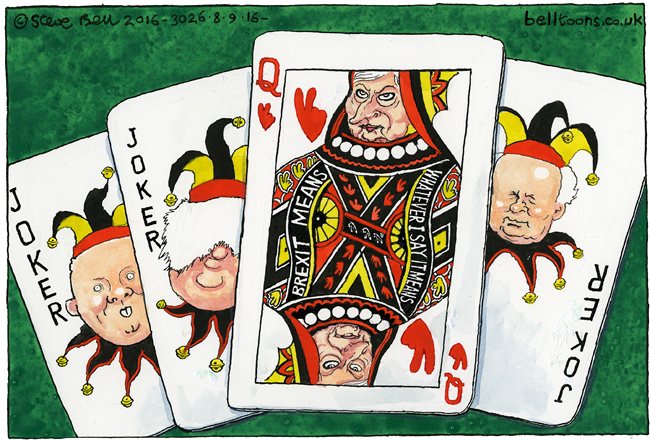
Yet Brexit’s once-simple meaning is fast unravelling, as even those who wielded it with confidence seem unsure as to what its two syllables are supposed to convey. The Prime Minister Theresa May, who is expected to know such things, has further fogged the semantic sense by giving it a now-infamous self-referential definition: Brexit means Brexit.  It’s as though Brexit itself were trying to wriggle out of meaning anything at all, unhappy at having been brought into the world, like Frankenstein’s monster looking for answers from its thoughtless creator. Brexit is exiting itself, self-sabotaging, divesting itself of lexical content and becoming so empty a signifier that it can mean all things to all people, which is to say, nothing at all.

‘Language is the house of being,’ Heidegger proposed, and we might wonder what being resides in words such as Brexit. A post-truth flexibility enabling permanent political evasion? Of course, Brexit is the latest in a long lineage of sophisms. There is the lexical deception of collateral damage, the smoke-and-mirror beguilement of asset for assassin. George Orwell, in his famous polemic against political language, Politics and the English Language (1946), condemned its use of ‘euphemism, question-begging and sheer cloudy vagueness’ to defend the indefensible.

Meaning, though, has always been precarious, as Alice found out when she wondered into Wonderland and met Humpty-Dumpty: ‘When I use a word […] it means just what I choose it to mean — neither more nor less.’ Naturally, Alice is disconcerted: can words really be made to mean ‘so many differnt things’? Humpty-Dumpty’s retort is that of all tyrants: ‘The question is which is to be master.’ A master-meaning, the one I mean it to mean; I, the one on high with all the power. The Guardian‘s cartoonist Steve Bell makes this point in today’s cartoon on Queen May’s regal raiments:

650

©Steve Bell 2016/The Guardian

Nietszche was likewise mistrustful of the disconnect between word and thing: ‘What is a word? The image of a nerve stimulus in sounds.’ In his very accessible albeit nihilistic On Truth & Lies in an Extra-Moral Sense (1873), he looks at these ‘arbitrary assignments’ and draws a rather damning conclusion:

What, then, is truth? A mobile army of metaphors, metonyms, and anthropomorphisms—in short, a sum of human relations which have been enhanced, transposed, and embellished poetically and rhetorically, and which after long use seem firm, canonical, and obligatory to a people.

So it will be with Brexit, which is already being ’embellished poetically and rhetorically’, already seeming ‘firm, canonical, and obligatory to a people’. And still the public and politicos plead, What does Brexit mean? And the only answer they hear is: it means what it means. C.K. Ogden and I.A. Richards’s book The Meaning of Meaning should be exiting the shelves (shexiting?) like a  Harry Potter off-cut in the coming weeks.

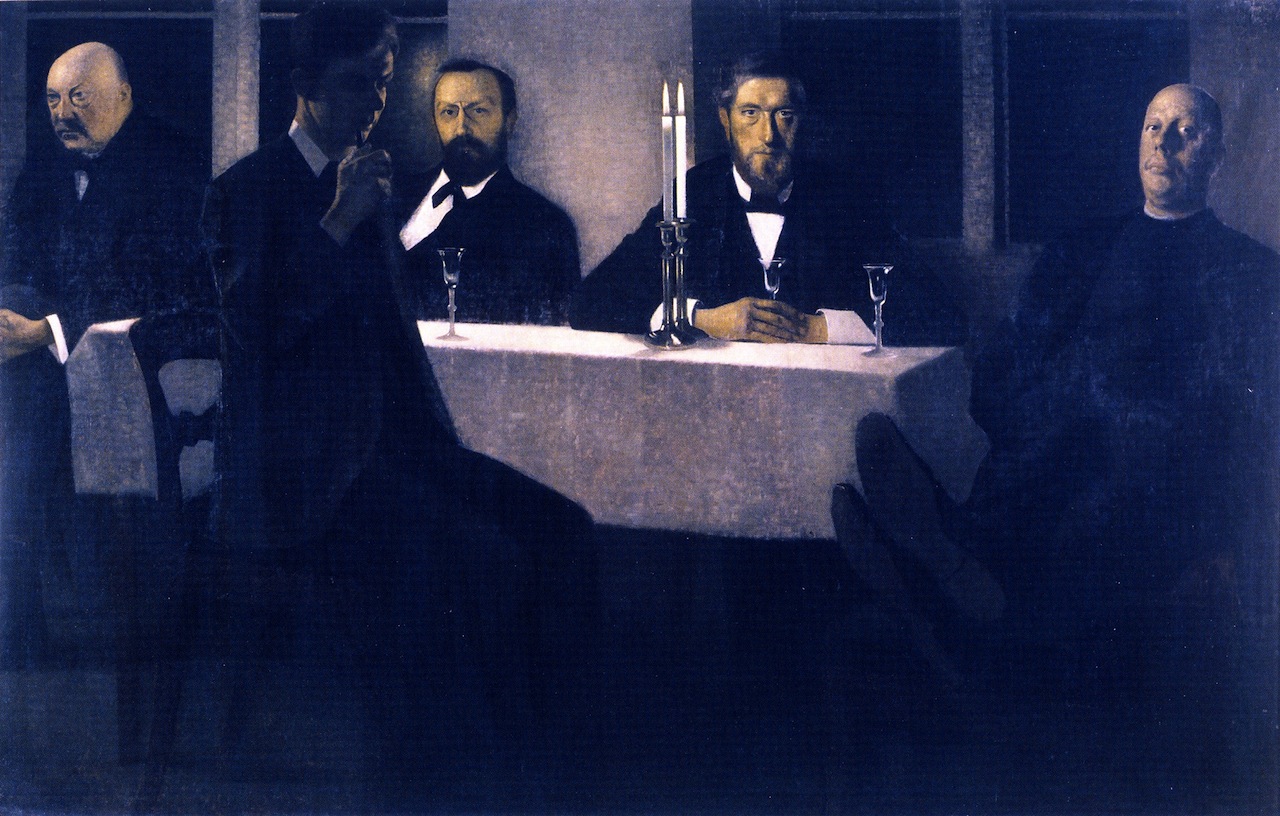
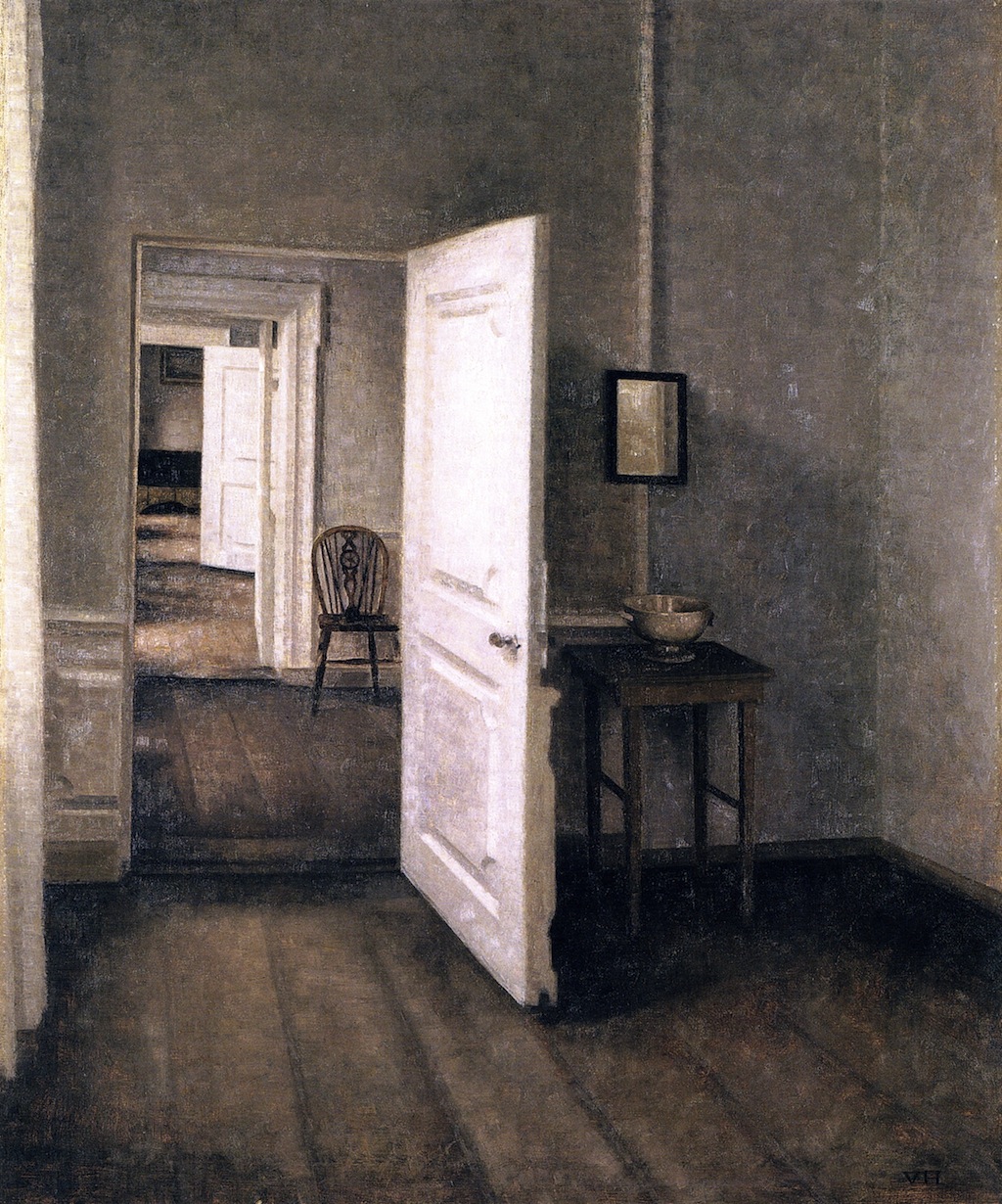
The painting is Vilhelm Hammershøi’s Five Portraits (1901-02).


Black Seas of Infinity: The Alien Sound-World of Georg Friedrich Haas

https://i0.wp.com/www.musicaustria.at/sites/default/files/bilder/2010/georg-friedrich-haas_c_astrid_ackermann.jpg

Photo © Astrid Ackermann.

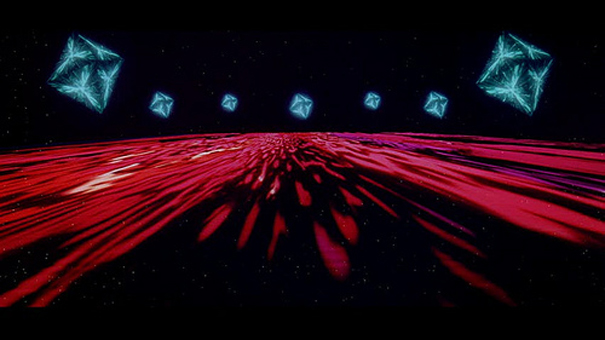
Music, always inhospitable to ekphrasis or literary description, seems doubly so when it’s not even typically ‘musical’, which the sound-worlds of the contemporary Austrian composer Georg Friedrich Haas are not. How to capture the ways this weird sonic world emerges almost organically, ex nihilo, like life itself, mutating, growing, pulsing, speeding up, slowing down, or coming suddenly to a stop. These are soundscapes on a vast scale: gigantic rotating planets, slowly warping architectonics, shimmering stillnesses glowing like the aurora borealis. This microtonal music (also referred to as ‘spectral’) finds its forerunner in the micropolyphonic world of the Hungarian composer György Ligeti, the eerie sonic hovering between tones of Atmosphères which Kubrick memorably heard as harmonia mundi, the Music of the Spheres, in 2001: A Space Odyssey.

Perhaps the best ekphrasis would be to quote HP Lovecraft’s vision of the cosmos:

The most merciful thing in the world, I think, is the inability of the human mind to correlate all its contents. We live on a placid island of ignorance in the midst of black seas of infinity, and it was not meant that we should voyage far. The sciences, each straining in its own direction, have hitherto harmed us little; but some day the piecing together of dissociated knowledge will open up such terrifying vistas of reality, and of our frightful position therein, that we shall either go mad from the revelation or flee from the deadly light into the peace and safety of a new dark age.

Here are those ‘black seas of infinity’, the ‘terrifying vistas of reality’, depicted in sublime slabs of abstract sonic pulses. The shards of pseudo-melody which occasionally emerge seem even weirder when they do. It puts me in mind of the new philosophical school of the Object-Oriented: perhaps Haas is composing sonic hyperobjects, or preparing us for the post-human world.

Screen-grab from Stanley Kubrick's 2001: A Space Odyssey © Warner Bros. Entertainment Inc.

Screen-grab from Stanley Kubrick’s 2001: A Space Odyssey © Warner Bros. Entertainment Inc.

Does the word ‘music’ even apply here? Does it even matter?  This will be noise to most, as it would have been to me but a few months ago, when I was all Bach and Beethoven, Mahler and Shostakovich, and this would have irked me into violent vocal derision. But then something clicked and its almost drone-like emergence, continuation, disappearance, anti-melodic swells of sound, pure, impure, but not noise (whatever that is), and not irksome. It now chimes offering a sort of mental consolation for the fuzzy logic of the world, a counterfoil to modern life’s dissonant overload. To quote Kafka in his Diaries, it bears me out like a friend.

Recommended Listening:

‘Different-Different But Same’: The Will To Homogenisation

It’s Saturday night. You head to the new gastropub which has garnered a reputation for offering something different. You order the smoked pigeon. It arrives on some vast alabaster dish that can’t decide if it’s a bowl or a plate. The food is stacked up in the centre, covered in various flowers, crumbs and savoury popcorn, with several blobs of gel and ejaculates of sauce daubed circumferentially around it.

The ‘Mackerel Marsala’ that follows is no different. And it’s the same story down the road at the more traditional boozer: chips are thrice-cooked and served in quaint baskets; burgers come in the mandatory ‘brioche bun’; wooden chopping boards and slate roof tiles act out as plates. Both pubs foreground the locality of the produce on their menus, ‘local’-ness having become just another brand, another way to market your menu as virtuous, ‘ethically-sourced’. Even the seasons aren’t spared: we drown in pre-festival fanfares – Easter, Halloween, Christmas; we are returned to the medieval with seasonal produce, spring greens, early asparagus, what have you. Here, then, is uniform difference: the will to homogenisation on a plate.

Medieval wooden platters are back in demand.

It is tempting to blame MasterChef or one of the many other cookery programmes which cling limpet-like to the TV schedules, to see them as producing a peculiar feedback cycle of demand and supply in terms of proffered dishes and ‘plating up’. The customer has seen those blobs of gel on TV, or had those ‘triple-cooked’ chips somewhere else, and now they want it that way here, too. But I think there is something more fundamental at work here: the will to homogenise isn’t restricted to gastronomy. High Streets, hairstyles, talent shows on TV . . . options narrow down into a blancmange of uniformity. Threatening complexity is reduced to something more easier to categorise and apprehend. The model of neoliberalism and its predatory hyper-capitalism is to assimilate, commodify, monetise until the market is super-saturated, then tweak and repeat. Nothing escapes. Originality, novelty, difference: all becomes subsumed into the homogenising system, fetishised by marketing gurus and media nodes as this season’s must-eat, must-read, must-see, must-do. What begins in one locale eventually becomes ubiquitous, national, transnational: pale baguettes and chewy macaroons on every supermarket shelf.

Anyone who has spent any time in South-East Asia will be familiar with the sales pitch-cum-philosophical mantra, Same Same But Different. The will to homogenisation results in a reversal of this axiom – in seeking to be different-different things become increasingly similar.

1012363620_f87f199080_o

Same form, different colour.

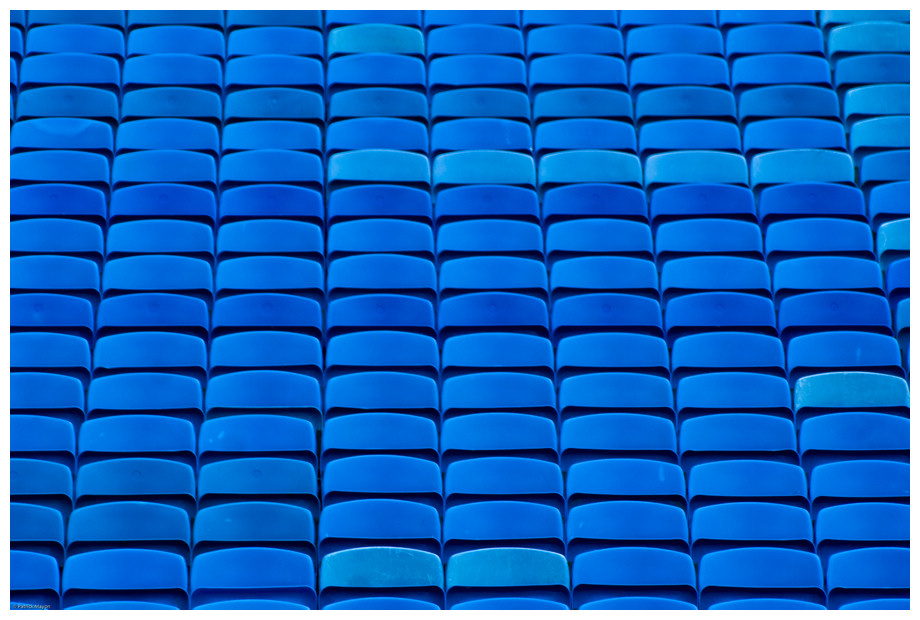
Researching photographs for this essay, I noticed how rare real uniformity is: the windows in those vast housing estates and skyscrapers had a curtain pulled to, a sticker, reflected clouds; the stadium chairs either bore an individuating number or reflected the light differently, turning its aquamarine blue more eggshell; one can imagine up close that each would have unique pattern of scratches, unique fungal knots of hardened chewing gum, graffiti, what have you. Objects seem to resist homogenisation even when mass-production forms them as such. Time and light transfigure them into individuated entities.  The will to homogenisation, borne of capitalism, and thus, borne out of the human condition, is ultimately thwarted, happily so for those who desire difference.  Whereas the complexity of the universe emerged from a singularity, all life on earth from fairly simple building blocks.

Heterogeneity and variation are elemental parts of organic life (evolution through random mutations); the will to homogenise is man-made and finds its purest outlet in the capitalist model, striving for a globalised village of branded stores selling the same branded goods via the same marketing methods. It engenders a dystopian vision of endless rows of sameness on the shelves and on our plates, where the critical room to manoeuvre and think differently enough to critique the system is increasingly diminished. Homogenisation is anti-life, predatory hyper-capitalism a form of hyper-fascism. In the long run, life and difference will win.


Food image by Franek N and stadium chairs by Patrick Mayon. Both used under a Creative Commons license.

Mozart and the Dormouse: On BBC4 Documentaries

The BBC don’t do book shows, at least not on TV, was a recent (and justified) complaint.

Oh, yes we do! they were quick to retort. What about Wolf Hall?

It was an interesting rebuttal, positing adaptation as literary critique. What, then, is one to make of the Guy Ritchie-fied The Musketeers as a critique of Dumas’s novel? It’s not hard to fathom why the BBC focuses on books as televion drama. Adaptations guarantee an audience, foreign rights sales, repeats ad infinitum, merchandise spin-offs such as DVDs, and ubiquitous media coverage, especially if your cast finds room for a Cumberbatch. How could a show of spoken literary opinion possibly hope to compete?

Furthermore, the once isolating event of viewing television is becoming increasingly communal through social media. Programmes are now hashtagged in media res on Twitter with the viewing public’s extemporaneous punditry. Post-broadcast, these viewers then flock to a newspaper’s episode-by-episode blog to post their long-form opinion BTL.[1] The standard TV critic’s job must now feel rather precarious, at risk of endangerment from the sheer volume and immediacy of ‘citizen criticism’.

A round-table TV show of critics discussing books must, I suppose, be seen as a massive turn-off for viewers by the BBC’s commissioning editors. It’s not something our French cousins have a problem with, not in other European countries. But there the noun ‘intellectual’ is not a dirty word. If its documentaries are anything to go by, BBC TV seems terrified of appearing intellectual or high-brow (not so, Radios 3 and 4, with the gloriously intelligent In Our Time and Free Thinking). I presume they perceive intellectual discourse as being antithetical to its modern-day striving for some wholly arbitrary and artificial notion of ‘balance’ and ‘inclusivity’. Even on BBC4, where anything even remotely challenging to the cerebral faculties gets shipped off to nowadays, the cookie-cutter documentaries all feature Brian Sewell’s much-loathed ‘arm-waggling presenters. The BBC’s film show replaced its serious-minded jumper-wearing critic, Barry Norman, with a slew of increasingly youthful Pretty Young Things (Ross, Winkelman), pop-culture savvy and designed to appeal to some imaginary audience which is always decreasing in age. Perhaps the dream is that, one day, the CBeebies and Arts programme audiences will somehow merge.

Infants certainly stand a better chance of understanding Tom Service’s inane babble in his recent ‘arm-waggling’ Mozart doc, The Joy of Mozart (BBC4). Service was guilty of the very hagiography and hyperbole he lamented in his opening gambit. Highlighting emphatically the hyperbole showered on the Austrian – ‘other-worldly genius!’, ‘divine gift from god!’ – Service sought to remind us dummies that Mozart was a human being, ‘just like you and me’ (thanks, Tom, because I had my doubts). He continues:

‘except he could express the pain and pleasure, the joy and darkness of being human, more completely, and more humanly, than any other composer’.

We are 42 seconds into the programme and after this breathtakingly banal statement, hyperbolic and hagiographic in the extreme, I want to turn it off. Add to this the fact that as he’s saying this piece to camera, a Salzburg waiter is trying to serve him coffee, only underscores the amateur quality of this production.

There were experts in there somewhere – a minute or two of Sir Nicholas Kenyon, the Mozart scholar Ulrich Leisinger – but they were competing with the over-excitable presenter, who even hounded one expert at the British Library until he half-concurred with Service’s intransigent point of view. Banality plumbed new depths with Service using the License Fee to eat a Mozart-emblazoned chocolate in Salzburg, and then speaking with his mouth full, as if this would in any way help to elucidate Mozart for us. The nadir, though, was the accompaniment of the word ‘billiards’ with the sound effect of balls clacking together: a bafflingly infantile addition.

Presenters weren’t always loudly bland arm-wagglers. One pines for Kenneth Clark and Sister Wendy: serious-minded, quiet-voiced, unaccompanied by bombastic soundtrack, given the time to speak at length as opposed to in 30-second sound bites. 2014’s ‘where is she now?’ documentary of Sister Wendy reminded me of how pleasant it is to spoken to, not bawled at, as in those aforementioned carbon-copy documentaries. Scroll through the TV listings and you can’t help but trip up over several. The titles usually employ lists of three – Maps: Power, Plunder, and Possession; Harlots, Housewives, and Heroines – which the producer learnt were good things during their GCSE English Language class, and have stuck to this credo ever since. What we get is some telegenic, hip academic mooning up at cathedral ceilings in exotic locales, or yawping blandishments and hyperbole over bombastically emotive soundtracks, instructing the dunderhead viewer how he/she should be reacting at this point: SPOOKY! EXCITING! DANGEROUS!

All of which brings me to the recent bookish documentary fronted by Martha Kearney, The Secret World of Lewis Carroll (BBC4), which again displayed the downward trajectory of documentary making at the BBC. In the post-Savile era, this was always going to be interesting and came with a stentorian warning: contains adult themes.

Having thus established that only adults should be watching because of the paedophilia content, we were soon watching cartoon rabbits bounding along a river bank in Oxford and a cartoon Cheshire cat smiling up a tree. It could have been a Chris Morris sketch. Although one could see the point of revisiting the riverbank where Alice’s Adventures in Wonderland was conjured up on a summer’s day, the addition of the cartoons surely only made sense for a children’s audience.

Then there were the repetitions, as if the audience were suffering from short-term memory loss and had to be constantly reminded of the documentary’s thesis statement: Dodgson might have been a paedophile, we just don’t know, because Victorians had different values to ours. The French refer to all this as allonger la sauce: diluting the story down, stringing it out to make up the format length and, one presumes, keep us on tenterhooks for the only new evidence the story had to present: a nude photograph of Alice’s sister, Lydia, aged 13, which required a visit to the South of France with an expert. [2] Such false suspense appended to the end was clumsy. Why not subvert this tediously formulaic narrative frame and work backwards from this revelation at the start, if only for novelty’s sake?

‘It’s a problem when someone writes a great book and they’re not a great person.’ Will Self

The programme reflected all possible views of Dodgson’s proclivity for photographing nymph-like females, fulfilling that essential BBC ‘balance’. It all felt like so much fence-sitting, awkward justifications for liking Carroll’s work but suspecting the man’s peccadilloes, terrified to take a stance. The nub seemed to be Self’s pertinent comment quoted above and Kearney’s questionable journalistic ethics: ‘I’m such a big fan of his work that I’m quite resistant to the idea of any possible dark side.’ The ‘shocking new evidence’ was not set in the context of a Victorian age of consent, ‘within the range of 10 to 12, but in 1875 the age was raised to 13‘, and again seemed to revert to ahistorical indignation in spite of its professed objectivity.

With all the expense lavished on these mish-mash historico-travel documentaries, and their failure to deliver anything like a coherent argument, one rather pines for the simplicity a round-table book review programme with someone restrained, eloquent, and intelligent chairing it would provide. Is Sister Wendy available?

[1] Below-the-line.
[2] In Kearney’s defence, she did say that the photograph was not allowed to leave the museum.

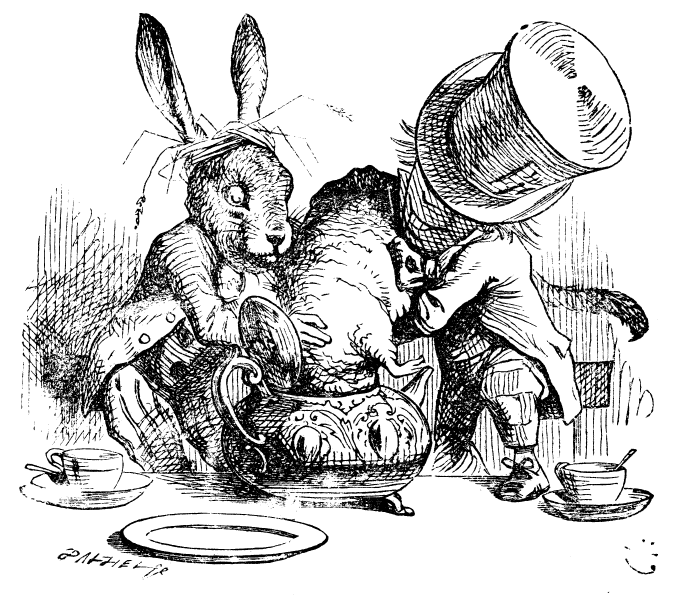
The Mad Hatter and the March Hare putting the Dormouse in the Teapot, illustration by John Tenniel


The Content of Content

The first in a series of short essays in which a word, concept, subject examines itself. Inspired by the title of C.K. Ogden and I.A. Richards’s The Meaning of Meaning.

Type in the word ‘writer’ into an online jobs portal and most results will have ‘content’ in the title. Content Editor. Content Manager. Content Developer. Digital content is everywhere in the Age of the Internet, where blogs, micro-blogs, social media, and websites proliferate and hypertrophy like irradiated giant squid in Japanese B-Movies, seeking to attract, entrance and cling on to the end user in the 24/7 digital content cycle.

Content needs to be managed, its performance measured and optimised, as it moves through its various distribution streams and channels. Fluvial euphemisms pile up like terminal moraines of gibberish. A knowledge of Content Management Systems, Search Engine Optimisation and Information Architecture is generally essential. And, of course, you’ll be happy communicating with internal and external stakeholders. The latter always makes me think of butchers.

Notice how the job advert addresses you directly – you’ll be happy. Oh, I will, will I? Naturally, all this content will be part of a 360 content strategy. 360 what? Degrees? Do they require circumferentially-correct content? Could it be days? If so, the maths is a little off. I suppose they assume that, if you have to ask, then you – you who were so happy to communicate with internal and external stakeholders – are not really right for the job.

In all these adverts, in which the above italicised metaphors appear with a consistency that suggests the writers have all either attended the same Optimal Content Management course, or use the same advert template, one thing remains consistently elusive: no one seems to want to say what all this optimised, managed, edited, manicured and pedicured content consists of. This content has no content. Very occasionally a reference is made to blog posts, social media feeds (content-enriched, no doubt, to strain the metaphor yet further), sometimes articles or newsletters are listed. But the subject and topics of these content formats remain absent.

Content, then, is an empty sign, a signifier which has no referent, and is the perfect metaphor for an age of proliferating text in which the thing being piped from screen to tablet to smartphone, flushed down a digital sewage system of streams and outlet channels, to an ‘end user’, not a reader, is ultimately of no consequence. The content of this content is of such little importance that it does not merit a mention in the adverts seeking someone to create it. What matters is the ‘end user’, the things they click on the page, and the amount of time they spend there. This data is usable, it has value, for advertisers and justifying marketing budgets, for creating content about the effectiveness of the contentless content that lured in the ‘end user’ in the first place. The secondary content not only has more substance than the original content, it both defines it and usurps it. Content finds its substance ex post facto: it only comes to have content in its second order of being. Some feat.

Content is king, the mantra goes. All, any. Those text boxes have to get filled somehow. The invisible reader, a statistical figure who costs so much time and effort to find the ideal content writer to create the contentless content, in order to provide the secondary data-driven content to define and supplant the empty first lot, is the grail at the end of every streamed channel. In its turn, the secondary content will become defined and supplanted through third-order manipulations, and so on in an infinite regress, as contentless content generates ever more content-filled content, until one day a PhD student will sit down to pen her thesis, Content and its Discontents.