The Corporate Realism Of Job Adverts

When did the language of job adverts become so arcane? It is a language unto itself – a meta-language that seems to lack referents in what passes for the concrete fabric of reality today. Who can actually point at a stakeholder and say, as Wittgestein once did of a tree, ‘I know that that’s a stakeholder’? But it is a word that persists in its internal and external form. A stakeholder can mean everything from a customer to the CEO, or a school pupil (internal) and their parent (external). These terms have a nasty habit of leaving their parochial domain (the corporate world) and infiltrating all institutions – schools, universities, hospitals, libraries – at least in their job ads.

Workflow is another advertisement leitmotif, its concise vagueness perhaps meant to suggest fluid working methods, a liquid labouring that is as ceaseless as the 19th Century Thames in its outpouring of productivity. Such opaque rhetoric is the language of neo-liberalism – the language of the free market that ‘corporatises’ vocations to better engineer a return on investment. Here is Corporate Realism, Capitalist Realism’s PR firm:  a future-oriented, growth-minded, ‘strivers-not-skivers’ tone and lexicon. At work is a brutal anti-poetry, where words become connotation engines, suggesting economic import at every linguistic turn. It is both exhausting and perplexing, since this job-specific language only seems to exist within this strange realm of job applications.

It is a discourse trapped in the symbiotic exchange between advert and applicant. The selection process starts here, with recognition of the rules of the game, the phrases which are to be repeated back at the parental job provider. Only the worthy individual who can pluck these semantic implements from the text and wield them correctly in their application will enter the kingdom of gainful employ. This is your initation into the cult of modern work – the mastery of its esoteric language.

You will be experienced in x.  You will implement y. Another noticeable feature is how driven the rhetoric is – as driven as you must be to meet its demands. In keeping with the going-forward-isation of our times, the future is a utopia which you will have helped shaped through continuous improvement.  It is a peverse twist on the Heraclitean notion of Panta rhei, where everything flows, nothing stands still: for your new employer, the improving will never be done. At the same time, communication can only ever occur across multiple channels, meaning you must be able to handle audio, video, and written ‘content’. That latter catch-all term is one I have examined already. Elsewhere, the language of business and warfare (‘strategic aims’) permeates even a post for a Special Educational Needs Teaching Assistant. Austerity, meanwhile, is visible in the sprawling duties and responsibilities whereby two or more positions have clearly been sandwiched into one starring ‘role’.

Yet use these words you must. A university workshop on CVs and cover letters instructed me how employers now perform keyword scans, outsourcing their own Human Resources labour to an algorithm – an irony that is too disheartening to be ever so droll. So I beat on, a solitary boat against the workflow, borne back ceaselessly into the Corporate Realist present.

Featured image by Ed Burtynsky of a Chinese factory.
The Exit of Brexit

A series of short essays in which a word, concept, or subject examines itself. Inspired by the title of C.K. Ogden and I.A. Richards’s The Meaning of Meaning.

When did the current fad for crudely conjoined portmanteaus begin? Was it the ungainly moobs that started it all, taking the m from man and supplanting the b of boobs with it? The media delights in coining compound celebrity couples, making mutant nomenclatures, such as Kimye, Brangelina and Hiddleswift. In ‘yoofspeak’, this is called ‘shipping‘, a verb derived from relationship. And now this modern habit has entered political discourse and, disastrously, we all live in a Brexit-ridden world.

Once (how long ago it seems!) it was simply an unhappy marriage of British and exit, and, despite its inelegant etymology and sonorous infelicity, its meaning was fairly explicit. Brexit was born out of Grexit – the Greek exit from the EU anticipated if that nation were to default on its debt repayments. It didn’t and Grexit slipped from view. With the EU referendum, a simple in/out became overshadowed by the newly-minted Brexit, and its over-exposure by a media incapable of refraining itself from jumping on any passing hashtag fad.

Yet Brexit’s once-simple meaning is fast unravelling, as even those who wielded it with confidence seem unsure as to what its two syllables are supposed to convey. The Prime Minister Theresa May, who is expected to know such things, has further fogged the semantic sense by giving it a now-infamous self-referential definition: Brexit means Brexit.  It’s as though Brexit itself were trying to wriggle out of meaning anything at all, unhappy at having been brought into the world, like Frankenstein’s monster looking for answers from its thoughtless creator. Brexit is exiting itself, self-sabotaging, divesting itself of lexical content and becoming so empty a signifier that it can mean all things to all people, which is to say, nothing at all.

‘Language is the house of being,’ Heidegger proposed, and we might wonder what being resides in words such as Brexit. A post-truth flexibility enabling permanent political evasion? Of course, Brexit is the latest in a long lineage of sophisms. There is the lexical deception of collateral damage, the smoke-and-mirror beguilement of asset for assassin. George Orwell, in his famous polemic against political language, Politics and the English Language (1946), condemned its use of ‘euphemism, question-begging and sheer cloudy vagueness’ to defend the indefensible.

Meaning, though, has always been precarious, as Alice found out when she wondered into Wonderland and met Humpty-Dumpty: ‘When I use a word […] it means just what I choose it to mean — neither more nor less.’ Naturally, Alice is disconcerted: can words really be made to mean ‘so many differnt things’? Humpty-Dumpty’s retort is that of all tyrants: ‘The question is which is to be master.’ A master-meaning, the one I mean it to mean; I, the one on high with all the power. The Guardian‘s cartoonist Steve Bell makes this point in today’s cartoon on Queen May’s regal raiments:

650

©Steve Bell 2016/The Guardian

Nietszche was likewise mistrustful of the disconnect between word and thing: ‘What is a word? The image of a nerve stimulus in sounds.’ In his very accessible albeit nihilistic On Truth & Lies in an Extra-Moral Sense (1873), he looks at these ‘arbitrary assignments’ and draws a rather damning conclusion:

What, then, is truth? A mobile army of metaphors, metonyms, and anthropomorphisms—in short, a sum of human relations which have been enhanced, transposed, and embellished poetically and rhetorically, and which after long use seem firm, canonical, and obligatory to a people.

So it will be with Brexit, which is already being ’embellished poetically and rhetorically’, already seeming ‘firm, canonical, and obligatory to a people’. And still the public and politicos plead, What does Brexit mean? And the only answer they hear is: it means what it means. C.K. Ogden and I.A. Richards’s book The Meaning of Meaning should be exiting the shelves (shexiting?) like a  Harry Potter off-cut in the coming weeks.

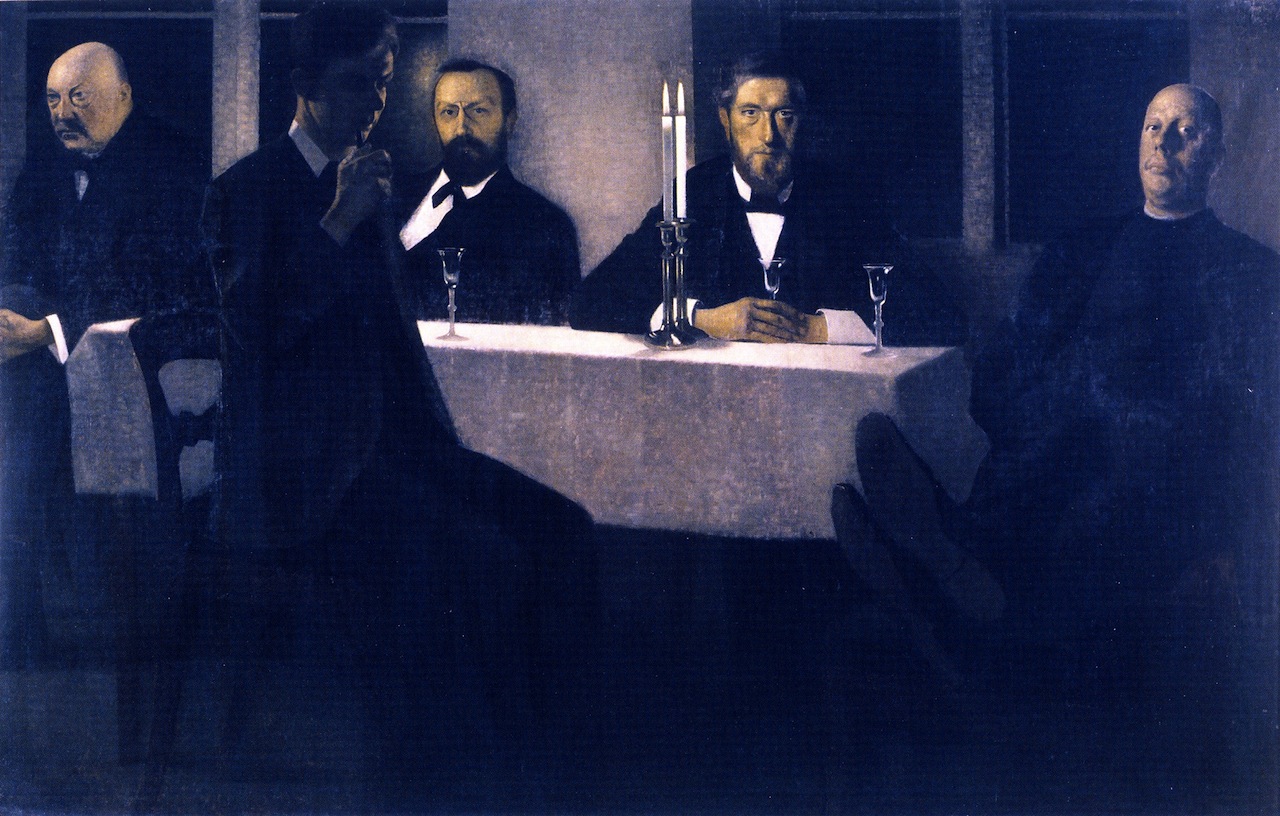
The painting is Vilhelm Hammershøi’s Five Portraits (1901-02).


The Lost Scarf

The now-lost scarf with its former owner

Here is, ostensibly, a very short story. My wife knitted me a scarf for Christmas last year. Three months ago I lost it in London. I still feel terrible about it. The end.

But I’m not going to let you go just yet. Let’s start with a cliché. You don’t know what you’ve got ‘til it’s gone. Winsome in their familiarity, these words contain something that is still worth examining. Was it only in losing the scarf did its preciousness, what it signified – the gesture of love, the hours spent making it – become apparent? That which is omnipresent is overlooked, discarded by the beholder.

The lost scarf leads to ontological considerations, too. The scarf exists in time and is made up of time – her time. Like Fates’ braids, the maker’s time was woven into the scarf’s physical existence. Now the scarf is lost, did she lose her time making it? But then the lost scarf still exists. In the above photo. In my mind. In my wife’s mind. And, perhaps, also in the material world itself. Around someone else’s neck. Or draped on a railing, bedraggled by the rain, awaiting ownership old or new.

Or should I be asking: when did this scarf actually come into being? With the wool? With the fleece of the sheep? Or with that sheep’s parents, whose genetic history predetermined the quality of the wool? Or the meteorological incidents and environment which shaped these sheep lives and, thus, their fleeces? Or with the farmer who owned and bred them? Or the diet they subsisted on? Or when these strands of black angora wool were finally enmeshed into the finished length? Or with the Platonic Ideal Form of ‘scarf’? When does any narrative start? At what point on the cosmological timeline do we say – here! here it began?

All of a sudden I am faced with the artist’s dilemma and a variation of Kant’s mathematical sublime: the story stretches back forever into the overwhelming past. Infinity is something that cannot be accommodated by human imagination; it literally cannot be imagined and requires Reason to provide the notion as a concept. So it is with narrative. It is the arbitrariness of all narrative which now strikes you, and which instils in the writer an anxiety which can forestall narrative invention: when to begin our tale if every beginning is a lie? And this anxiety creeps out of fictive realm into fact. When do we begin our histories: with first causes? The Big Bang?

The reason for this essay was an afternoon spent drifting through Routledge’s The Object Reader The final section of the book is entitled ‘Object Lessons’ and comprises essays by contemporary theorists on an object. It led me to consider what I would write about for such an ‘object study’, and the contrarian in me chose an object that had been lost. An apologia. A writing-back-into-existence that which is absent, which is, essentially, what all writing is: a re-affirmation of what really was.

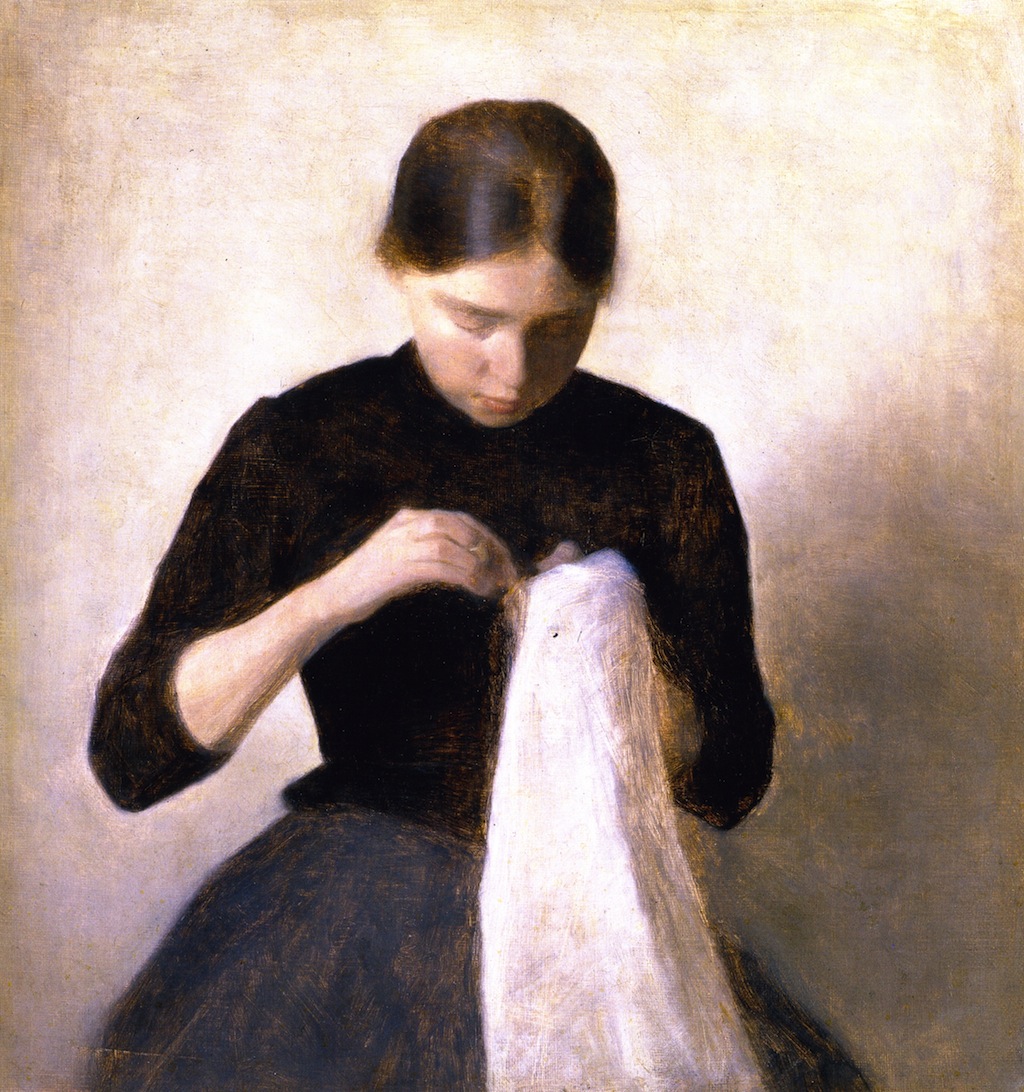
Young Girl Sewing. Anna Hammershoi, the Artist’s Sister Vilhelm Hammershøi (1887)

The Content of Content

The first in a series of short essays in which a word, concept, subject examines itself. Inspired by the title of C.K. Ogden and I.A. Richards’s The Meaning of Meaning.

Type in the word ‘writer’ into an online jobs portal and most results will have ‘content’ in the title. Content Editor. Content Manager. Content Developer. Digital content is everywhere in the Age of the Internet, where blogs, micro-blogs, social media, and websites proliferate and hypertrophy like irradiated giant squid in Japanese B-Movies, seeking to attract, entrance and cling on to the end user in the 24/7 digital content cycle.

Content needs to be managed, its performance measured and optimised, as it moves through its various distribution streams and channels. Fluvial euphemisms pile up like terminal moraines of gibberish. A knowledge of Content Management Systems, Search Engine Optimisation and Information Architecture is generally essential. And, of course, you’ll be happy communicating with internal and external stakeholders. The latter always makes me think of butchers.

Notice how the job advert addresses you directly – you’ll be happy. Oh, I will, will I? Naturally, all this content will be part of a 360 content strategy. 360 what? Degrees? Do they require circumferentially-correct content? Could it be days? If so, the maths is a little off. I suppose they assume that, if you have to ask, then you – you who were so happy to communicate with internal and external stakeholders – are not really right for the job.

In all these adverts, in which the above italicised metaphors appear with a consistency that suggests the writers have all either attended the same Optimal Content Management course, or use the same advert template, one thing remains consistently elusive: no one seems to want to say what all this optimised, managed, edited, manicured and pedicured content consists of. This content has no content. Very occasionally a reference is made to blog posts, social media feeds (content-enriched, no doubt, to strain the metaphor yet further), sometimes articles or newsletters are listed. But the subject and topics of these content formats remain absent.

Content, then, is an empty sign, a signifier which has no referent, and is the perfect metaphor for an age of proliferating text in which the thing being piped from screen to tablet to smartphone, flushed down a digital sewage system of streams and outlet channels, to an ‘end user’, not a reader, is ultimately of no consequence. The content of this content is of such little importance that it does not merit a mention in the adverts seeking someone to create it. What matters is the ‘end user’, the things they click on the page, and the amount of time they spend there. This data is usable, it has value, for advertisers and justifying marketing budgets, for creating content about the effectiveness of the contentless content that lured in the ‘end user’ in the first place. The secondary content not only has more substance than the original content, it both defines it and usurps it. Content finds its substance ex post facto: it only comes to have content in its second order of being. Some feat.

Content is king, the mantra goes. All, any. Those text boxes have to get filled somehow. The invisible reader, a statistical figure who costs so much time and effort to find the ideal content writer to create the contentless content, in order to provide the secondary data-driven content to define and supplant the empty first lot, is the grail at the end of every streamed channel. In its turn, the secondary content will become defined and supplanted through third-order manipulations, and so on in an infinite regress, as contentless content generates ever more content-filled content, until one day a PhD student will sit down to pen her thesis, Content and its Discontents.