
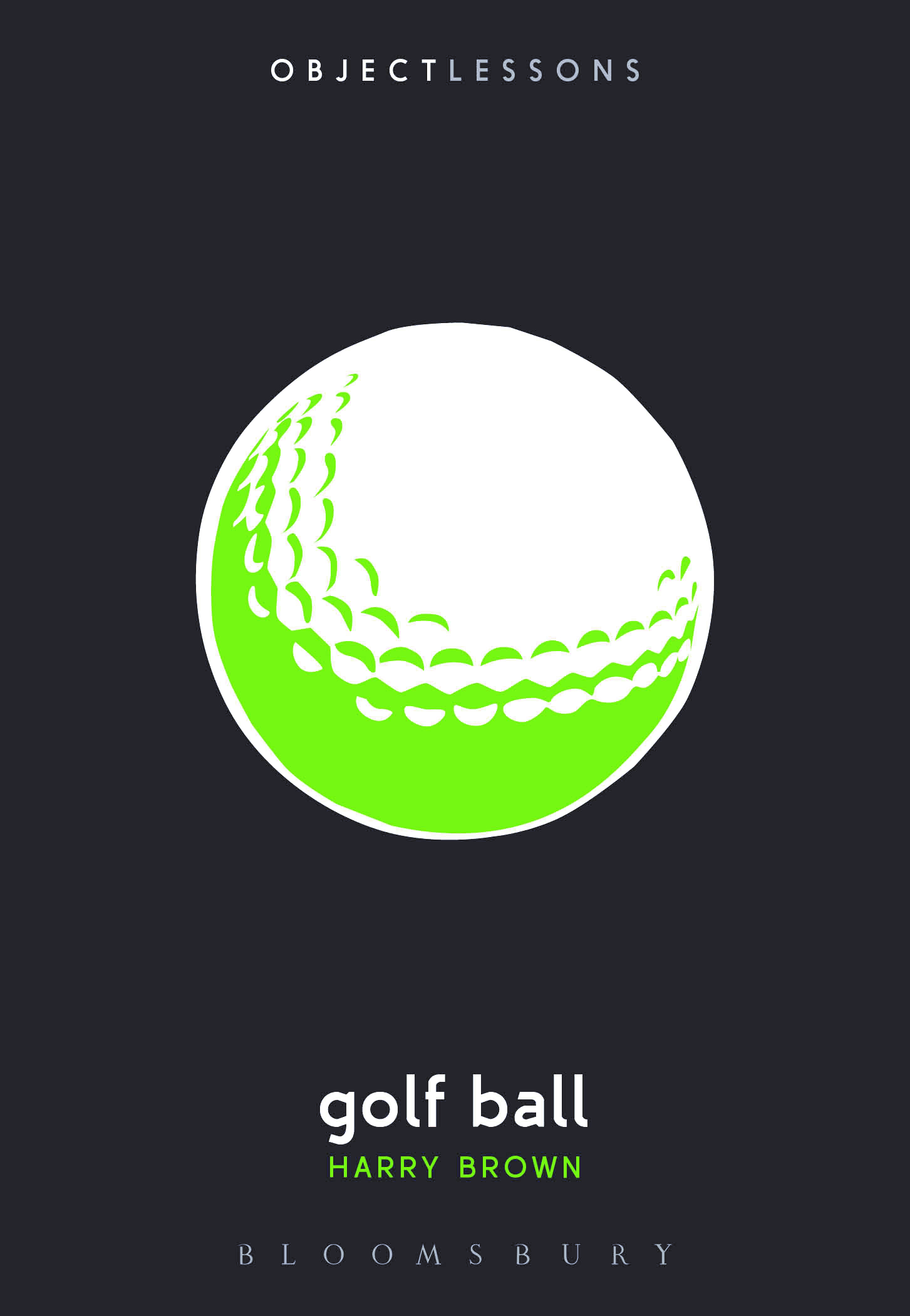
 Part of a series entitled Object Lessons published by Bloomsbury and edited by the American academics Ian Bogost and Christopher Schaberg, Harry Brown’s Golf Ball sounds more like the sort of extended essay school students are set when doing detention. It might seem impossible to make such an object interesting but this is just what Brown achieves over the course of 128 pocket-sized pages. His cultural study is an intriguing mix of history, personal anecdote and cutting-edge philosophy, carrying the reader aloft over a range of courses and discourses past and present.
The eccentric approach to his topic is apparent from the off, both in the comical chapter titles (How the golf ball keeps holy the Lord’s day) and a bravura opening passage which begins with an anatopism: a Kalahari Bushman finding an empty glass Coca-Cola bottle in the desert, which is subsequently worshipped by his tribe and leads to jealousy and violence. The Bushman finally determines to take this ‘evil thing’ to the end of the world because ‘it doesn’t belong on earth’.* This idea of unhuman objects will eventually (and cleverly) be merged by Brown into the new philosophical realm of Speculative Realism, positing the golf ball in a post-human time and space.
The book is divided into two golfing halves, nine outward ‘holes’ revolving around ‘Thing’, and nine holes coming back in entitled ‘Phenomenon’. The first half of the ‘course’ is studded with interesting facts about the ball itself, for example, how the composition of balls have changed over time in relation to the British empire – from leather and feathers to Malaysian gutta-percha to modern polymers, and how these innovations have themselves changed the game of golf, with course designs altering to accommodate the huge distances which the modern balls can now be hit. We also learn about: the profit to be made in recovering lost golf balls (5 million dollars a year for one American company) and the lawsuits such ‘recycling’ and ‘refurbishing’ has led to; the unusual ways golfers mark their balls to differentiate them when playing (the Northern Irish Darren Clarke draws a green shamrock, Nick Faldo a ‘6’ to represent the number of championships he has won); and the cachet certain golf balls carry, such as the Penfold Hearts used by James Bond in Goldfinger, with Brown cleverly linking this ‘cool’ to Marxist notions of ‘commodity fetishism’. I should add that, refreshingly, all facts and quotations are thoroughly annotated via end notes for each chapter.
The second half concentrates on human interactions with the ball and how to hit it, drawing on Mihaly Csikszentmihalyi’s psychology of happiness book Flow, Zen Buddhist notions of hitting it through not trying to hit it, and the impact of various famous golf guides, such as Jack Nicklaus’s bestseller Golf My Way. Brown also speaks of his own golf ball anecdotes: the time he cut a ball in half as a youth reveal its weird rubber band and liquid polymer interior; the trip to the West Coast of Ireland and his metaphysical experience driving balls from a cliff into a sea of fog; how his father hid golf balls in the foundations of a new housing development in order to befuddle future anthropologists. This eccentric action brings us to the really intriguing aspect of this object-oriented book: the golf ball’s durability.
Brown reveals how animals have begun to co-opt these foreign objects into their lives, with lampreys and red-tailed hawks using them to line their nests. He focuses in on a decomposing gutta-percha ball, the product of a Late 19th Century rubber factory, that has become the home of ladybirds:
The earth itself ushers the golf ball to the next stage of its evolution, changing it from an industrial object existing in historical time to an organic object existing in biological and geographic time.
In the final chapter – How the golf ball prepares for Doomsday – he considers how long the millions of lost polyurethane balls will take to degrade and the possible ecological impact of this. Making nods to the ‘speculative turn’ of recent philosophy and Object-Oriented Ontology (OOO), Brown draws on Timothy Morton’s notion of the ‘hyperobject’, that man-made objects such as golf balls will outlast the species which created them in the cosmic timeline.
The author does occasionally slice a few shots along the (fair)way. An overly frequent point of reference is Michael Murphy’s Golf in the Kingdom, which seems to be a sort of Zen and the Art of Motorcycle Maintenance for golfers, with its mystical guru Shiva Irons waxing lyrical about ‘true gravity’, and remaining (paradoxically) an overfamiliar and still obscure figure by the end. Some may also find the personal anecdotes and mystic thinking (Zen, pop psychology references) a little self-indulgent: the aforementioned golf-balls-off-a-cliff incident comes washed in a Kerouac-tinged haze.
But these are minor gripes. In Golf Ball, Brown has some fun with contemporary thinking whilst never getting too bogged down in the sand trap of theory, the philosophical and phenomenological nuances adding an extra heft to a detailed and often perceptive account, leaving us with some intriguing questions to ponder about the objects we use, lose and overlook every day.
*The film cited for this scene, The Gods Must Be Crazy, is a controversial South African comedy of questionable racial intent, something which is not made apparent in the book under review. I am grateful to @Nick_deKlerk for providing this additional context and a link to the relevant scene:
Featured image ‘Alignment (Golf balls)’ by onigiri-kun and is used under a Creative Commons licence.

 Neil-Fitzgerald.com