The Zone of Interest and the Black Box of History

A moment of sublime astonishment comes at the end of a film bathed in disturbing awe – the film being Jonathan Glazer’s The Zone of Interest (2023). Auschwitz Commandant Rudolf Höss (Christian Friedel), arch-functionary, descends a barren staircase. This arriviste loser has previously been socially out of depth at a party function. Here he returns to more concrete things: his office building. This is terra firma for the high-functioning bureaucrat.

Descending the stairs, he suddenly finds himself retching yet no vomitus materialises. Another round of stairs, another retch, and still no vomitus. Is this his inability to feel disgust at what he does? Or is this, we hope (counterfactually), the first inkling of the horror that he is personally overseeing?

He then stares into the black void down the end of a corridor, and the corridor seems to stare back at him. When it does so, it is the future staring – as the film pivots to the present-day Auschwitz Museum and cleaners hoovering the gas chambers, polishing the black iron of the ovens, dusting the rows of display cases containing what remains of the dead: empty shoes.
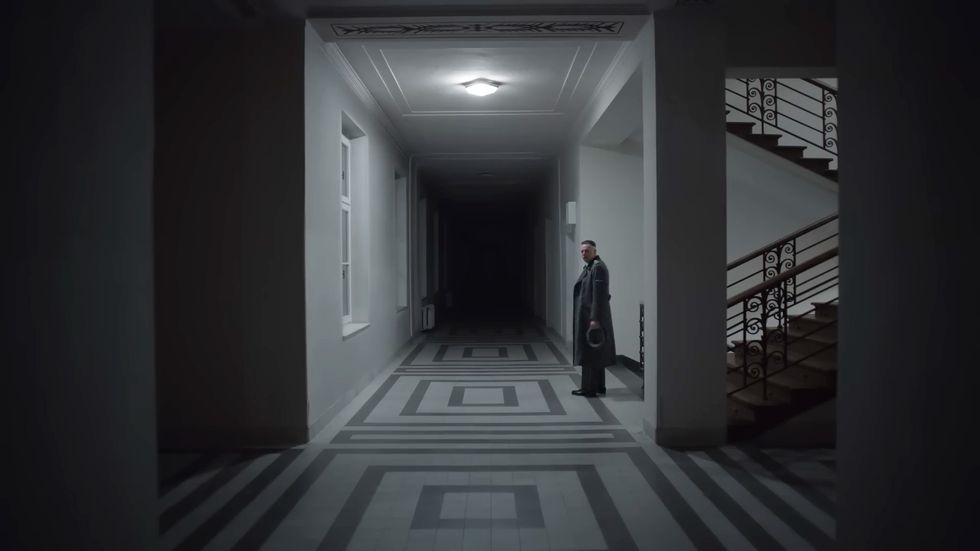
At this moment, Höss seems to have caught us in 2024 watching him, judging him – an uncanny fracturing of the Fourth Wall.

Cinema has seen this trick before – the past becoming colourfully present. Spielberg’s Schindler’s List (1993)) does it. Perhaps it is a necessary transition as if to show how such seemingly distant ‘black-and-white’ history lives on in the colour of the present. What makes Glazer’s film different is that his film then pivots back to Höss. This is Glazer’s masterstroke. I couldn’t help feeling that this was almost a plea for what philosopher’s call Presentism- that the present is the only thing that exists, or that everything is present. Thus, here the ‘future’ (merely a changed present) is already there in 1943 judging him. It is right there down that corridor, out of sight but also present. That if Höss had understood this he might have acted differently, as other Germans implicated in such horrors might have. And how, if we too understood this, we would all act differently every day of our lives.

What, then, is this strange minor breakdown in the automaton-like Höss? A sense of future judgement niggling him somewhere in the unfathomable interstices of his conscience? If so, it lasts a few minutes only. He adjusts his hat, and continues his descent – literal and metaphorical – into his immediate future of Semitic annihilation.

The black void at the end of that corridor is a familiar Glazer ‘black box’ containing all that remains unknowable about human actions: we know inputs (Nazi ideology, anti-Semitism) and outputs (6 million dead Jews), but what lies in-between the two? Such opacity is, alas, catnip to Holocaust deniers. It is the same void of Under The Skin (2013), where female being, or, if you like, ‘alien being’, or simply Desire, is shown to us in its stark unknowability. It appears on one of The Zone of Interest’s film posters inking out the eternal blue sky of that summer. It is a void which refutes our enquiry. It is Nietzsche’s abyss staring back at us.

Indeed, the film is bookended with black boxes. There is the bold ‘fuck you’ opening cinematic black screen immersion, as Mica Levi’s (and Johnnie Burn’s) uncanny sound world leaches into us, creating the unsettling mode-of-viewing that will reside for the entirety of the film. Could we be in a lightless train carriage hurtling towards the ‘black box’ of Auschwitz? Could this even be an attempt to represent the gas chamber? Or does that come at the end, where Levi’s demented sounds take on an unbearably frenzied sense of horrific desperation?

Glazer’s film is a masterpiece of defamiliarization, of making Auschwitz seem newly horrific. He re-disturbs us to the core of our being, waking us up from the slumbers of history, from some fatal ennui borne out of over-familiarity, of what risks becoming a mere trope, cinematic shorthand for ‘the worst of us’.

Glazer, and his co-creator Mica Levi, are surely right to be considered avant-garde. Such unorthodoxy is no doubt necessary for art in the ‘always on’ media-saturated world of streaming. It is reassuring, too, that such 10-year commitments can pay off; that cinema can still disclose and enact such necessary horror.

Je suis pas Charlie – je n’ai pas leurs couilles.

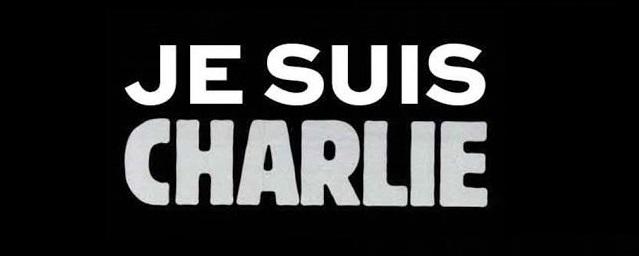
It happened with Mumbai, with Norway, and now with Charlie Hebdo in Paris. The social mediatisation of terror spectacles seems to evolve like the time-lapse photography of biological growth. The tweets and hashtags multiply and metastasize before your eyes, as everyone has to have their say, no matter how trite. The hypocrisies vie with false declarations and empty sloganeering in a failed gesture of solidarity: Je Suis Charlie now, when it’s too late, but not before, when it actually mattered. Self-expression entwines with self-publicity, as the hashtag is seized by wholly unrelated entities. The mass media vultures quickly pick the bones clean, ensuring every angle is covered, however absurd and inconsequential, as if to lay claim to the narrative, nourishing the story for the readers it brings in. Soon the Islamophobics will claim it for themselves, too.

Then the ritual of statecraft begins: the premiers and presidents lining up to say solemn blandishments that say nothing, each trying to outdo the other, so that hyperbole inevitably creeps in, with Sarkozy suggestion not just democracy but all civilization had been attacked. Doleful announcements about transcripts of phone calls being made. Ironies abound that would not be lost on Charlie Hebdo, as authoritarian states who lock up cartoonists profess disgust at the attacks. Videos emerge of ‘how we observed the minute’s silence’ for Charlie Hebdo, a mournful video selfie that is wholly self-serving. ‘We are proud to wear the Je Suis Charlie logo’, writes one newspaper, the safe logo that signifies a lack of courage to publish the very cartoons which you claim are expressions of democratic freedom of speech. And so on, and so on, as Zizek would say.

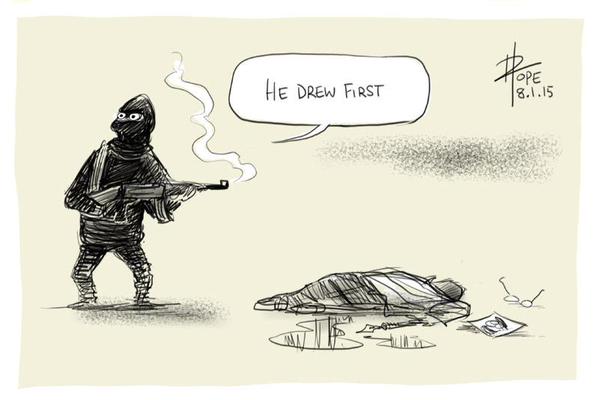
Satirists and cartoonists respond admirably with bitter satirical cartoons. Journalists appropriate this attack for themselves. Free speech and freedom of the press are wheeled out, as self-censorship takes place: no British newspaper ran with a Charlie Hebdo cartoon on its cover, or even showed pictures of the dead cartoonists. Instead, the propagate the death cult myth of the terrorist agency, showing the assassination of the injured policeman on the street, labelled ‘barbaric’. Isn’t it also barbaric to act as a proxy PR agency for the militants?

Australian cartoonist David Pope’s response.

Commentary, too, tiptoes around the valid issue of Militant Islam, terrified to offend. And there are valid reasons for this. An employer needs to protect its employees against reprisals. But this does mean that speech isn’t as free as it once was. And you can’t claim it is, or uphold it as a foundation of democracy, if you are running scared yourself. And so the terrorists have already gained ground. Je suis pas Charlie – je n’ai pas leurs couilles. I don’t have their balls. We, none of us, have the courage of their convictions, to say like Stéphane Charbonnier better ‘to die standing up than live on your knees’. My own satirical musings picked safe targets: Tom Cruise, Kanye West, Ray Mears – through parody Twitter accounts and blog posts. Not even the Scientologists protested. I played it safe, erred on the side of caution and cowardice.

There will, of course, be questions asked about the protection offered at Charlie Hebdo, but there is no total protection against automaton-like militancy, with its irrational logic. Indeed, the repeated mentions of the shot policeman being Muslim fail to understand that this does not exonerate him from the ‘true believer’: to his skewed thinking, the fact he sports a police uniform and is working for the French state means he is now a ‘legitimate’ target.

Amidst the muddled explosion of expression in the face of the event, there are plenty of wrong notes hit. People revert to selfish stances: what about me? Could it happen here? There were several tweets by Americans asking this, despite the frequent non-terrorist mass deaths caused by gun crime. This in itself is interesting. It is the Other which terrifies. The white suburban mass murder we can fathom. The white Christian fundamentalist (Norway’s Breivik) does not overwhelm the senses. The black flag, the illegible linguistic script, the language, the religious chant, the raised finger…all this fills the mind with sublime notions of terror whose potency comes from its otherness. It is the ideology behind it that terrifies, that is sublime.

Typically, we think of this as something monumentally vast or infinite – the sea, mountains, the innumerable galaxies in space. But sublime terrorism needn’t overwhelm the senses like September 11th 2001 with the vast spectacle of a world-historical event, immense pyroclastic dust-clouds of massive skyscrapers brought down by political ideology – what Zizek calls the sublime object of ideology is in that cloud and the plumes of smoke visible from space. The remorselessness, the anti-humanity writ small and metropolitan, can do this. The image of the policeman, reeling on the floor injured, as helpless as an upended tortoise, rocking side to side, immobile, no threat, and the brutal dispatching – the brief look downwards, a single bullet to the head – his step is hardly interrupted by the act, automaton-like in its mechanisation. Here, too, is the sublime object of ideology. Our expectations of humanity – crouching down to offer assistance, extending a hand to help him up – is cruelly thwarted, and in its place is something unknown, uncivilised. Here is an an incomprehensible anti-humanitarianism. The senses are overwhelmed. Reason cannot grasp the depths of the hatred, of unfeeling, on display.

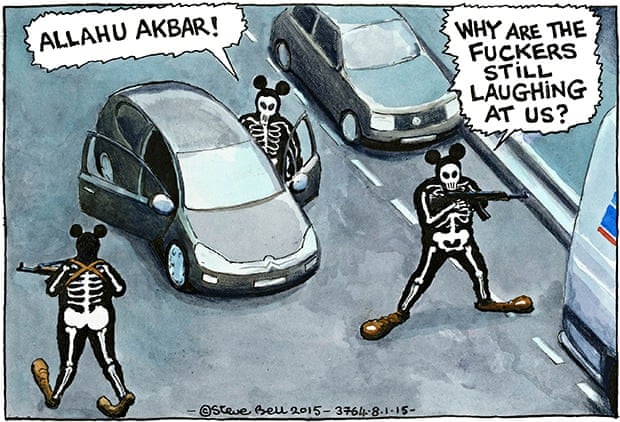
Source: The Guardian (©Steve Bell 2015)

Another flat note was Steve Bell’s cartoon in the Guardian which portrayed the attackers as a Mickey Mouse death cult. It doesn’t work. The idea that satire and free speech can be silenced through terror is laughable, yes, but the terrorists themselves do terrify. Think of it. A typical grey January day in Paris, when you are forced at gunpoint to unlock a front door that you know will lead to a massacre. Forced at gunpoint to reveal the location of the Charlie Hebdo office that you know will lead to mass death. Forced at gunpoint to say your name, which you know will lead to your murder. Assassinated in front of your co-workers. These co-workers aware they are next. The gut squirms at the mere glimpse of the dread they must have faced. Again, this is the sublime manifestation of terror, as defined by Kant and Burke and picked up on by Zizek, overwhelming the rational senses, incapable of being vicariously imagined.

I hope Charlie Hebdo can survive. A French friend described them as ‘shaking the tree, making peope think’, almost anarchic in that they attacked all creeds, religious, political and ethical. Democracy examines itself through its satirists, exposing the hypocrisies, the cognitive dissonance, the bullshit, forcing us outside habitual thought patterns, making you go Huh as well as Ha.